On Monday, after the creative writing workshop, I started to think about my blind contour drawings of Borough Market as a sort of observational poem. I was wondering how they could weave and twine together, so I started playing around with them on photoshop.
Image of all of the Line Drawings Combined
I quite liked the idea of printing these line drawing out on large, transparent paper and allowing shadows to fall and criss-cross on the floor, depending on how the light hit them. I am interested in this ceiling determining the breadth of the market–how it feels underground, but as if the arches create their own sky.
Experimenting with Blocks of Color in Illustrator
Then, I started to experiment with what happened to the visual space that was created by using blocks of color, as I remember them from the market. Eventually, Caio told me about live paint, and that process became a little quicker.
The forms take on a whole space when the images are overlayed, even though they come from different perspectives of observation in different locations throughout the market.
Then, I started thinking about 3D applications/how these would have different effects at different scales.
I am excited to do some more drawings and to play with installation, though it does feel like a bit of a radical break from the observation I was doing in Trafalgar Square.
I was sick throughout the weekend, but I finally started feeling better on Sunday. I was feeling quite inspired by the communications pathway session that we had on Thursday about re-engaging with the city with our eyes closed, and by using different parts of our bodies to log information from the city.
I was feeling a little stuck with Trafalgar Square, so I went to a place that was quieter on a Sunday–still on the Northern Line–Borough Market. This market is interesting to me too in terms of the spacial demarkations and zone-ing that we have been exploring in Trafalgar Square. There of course is the physical and visual demarkation based on what stalls are permanently or transiently set up in the markets. However, the competition for the air is different. Sound doesn’t draw people so much as smell.
When Neveah and I walked around there the first time we noticed that the smell of cheese was intermingling with the smell of fudge with the smell of coffee. This was not necessarily pleasant. It was an interesting juxtaposition with all of the criss crossing arches of iron above, for the underneath part of a bridge.
In fact, it was an interesting reversal in comparison to Trafalgar Square with this nearly sub-terranean marketplace. Instead of being above rumbling trains, they were now rumbling way above our heads.
I am drawn to the visual complexity and layering of the ‘ceiling’ of the market, so I started to draw it like I would an illustration from observation. However, I quickly became a bit too obsessed with the accuracy of the geometry. It was a bit like there was something fascinating to me about what I wanted to draw based on the holistic experience of looking up, but all of the boring parts were getting in the way, because I had to build up to the interesting stuff.
So, I drew on Thursday’s pathway session to draw with my iPad using blind contour. The visual part was still interesting, but I would only permit myself to look and linger on that looking. I would let my eye focus where it wanted to focus and have my hand record what it could.
I turned around different corners and drew from different perspectives according to whatever was interesting visually. It felt very indulgent, but I liked what I produced so much more.
I am thinking that I want to return and make many many more of these illustrations, and perhaps I will print them up on large scale transparent paper and install them from the ceiling.
I started making these little drawings of street performers in the style of the Charing Cross Mural by David Gentleman which depicts how the first physical Charing Cross was built at the sight for Queen Eleanor. Evidently, the Queen died outside of London, and her coffin was taken to London over a long journey, which required many stops. Wherever the coffin ‘paused,’ the King had a cross commissioned to be built in order to commemorate the journey, and Charing Cross was the sight where the coffin stopped in London.
The mural depicts the actual building of the cross according to 13th century building procedures.
I have always been struck by them as I pass the Charing Cross stop on the northern line because they are so graphic. It is interesting to me too that when one surfaces to Charing Cross, one is confronted with so many different monuments. The cross itself, which evidently is a Victorian replica, according to Historic UK, stands quiet in comparison to the loud grandeur of Nelson’s Column in Trafalgar Square. Even though it is the name of the underground and a general reference point, the two locations get mixed up, with the history of a story of a man monumentalizing his wife’s death underneath a monument of a war hero, elevated higher than any monument in the vicinity.
The competing histories struck a discordant chord. Too, the mural depicts the building of the cross. There are some important figures in the mix, but by and large it is a story of every day people–people who returned to the sight every day in order to use their specialties to create an identity for the space.
This brought me back to street performers. Perhaps these people are seen as low level entertainment, but they are the craftsmen of the sight for our day. They aren’t necessarily commissioned to be at the sight, but they do come because of the grandeur of the space.
I was interested in this historical intermingling, so I crafted these images of street performers who I have seen in my many visits to Trafalgar Square in order to originally be inserted into the original mural at life size. Some are more visible than others, but the point is to pick through the pieces and to question what this actually is and the ephemeral nature of craft and creation that go into a space. Weirdly, even the street performers are sort of people who are unseen except for their craft.
The images have only materialized as small stickers so far, and we have integrated them above and below ground in Charing Cross and Trafalgar Square as a hint to these adjacent histories and the dichotomy of above ground and below ground. But, I think they exist best as a whole image together, just as the history melds.
Perhaps I will print them out at a larger scale and install them above ground.
On Tuesday, in order to flip the experience we had the previous week on its side, we decided to go into Trafalgar Square on the offense. I had bought some sidewalk chalk in the though that we might draw something and participate in the square that way. However, we couldn’t think of something intentional that we would want to draw with sidewalk chalk. It is still an area for consideration, however, as is drawing shapes and mazes with water on the pavement that evaporate in a matter of moments.
For this particular experiment, I made a white sign with the word ‘CONVERSATIONS!’ written in black acrylic paint, and I planned to stand there and record audio while Neveah filmed. We had talked to Ian beforehand about the nature of real-estate in Trafalgar Square. On one level, the way that performers arrange themselves is just for maximal visibility because of its correlation with the most money you can get, and the way that tourists arrange themselves tends to be around where they can best see said street performers or where they can get the best photo from their holiday, to document the fact of their being in Trafalgar Square. There seems to be a transactional nature about this exposure.
So, we decided to go into Trafalgar Square with a hybrid incentive. We would take the positionally of street performers to be hyper visible, but what we were getting was more of the nature of the tourist, a documentation of our experience within the place. In order to incentivize people to talk to us, I created some stickers in the style of the David Gentleman’s Charing Cross mural that decorates the walls of the tube via the northern line under the surface, but instead of depicting people from 8 centuries ago in the construction of eponymous cross, I made street performers.
It was very awkward at first. However, there was a certain protective nature of the sign and the camera that established we were in control of the situation. Going up to people to ask them their opinions has always felt a bit intrusive to me. Inviting people in felt much more like a choice on both party’s positions.
Having a camera and a recording device definitely changed the dynamic of the conversation. The people that came to talk to us were quite aware of the camera, and they cheated out accordingly. The conversations felt more like performances rather than discussions, so perhaps when we run the experiment again, we won’t go out with devices. We can just rely on our memory to stitch together the performance. I know I wanted it to be more about interacting with people than documentation, so if we have to sacrifice the documentation piece, that is okay.
One of the most interesting things about this performance was how ‘visible’ we became because of the sign and the camera. I would say that the sign was an even stronger force than the camera. There was this natural curiosity about people who wanted to see why a person would be stopped in Trafalgar Square. I could hear people making remarks about me and taking pictures of me, though only a few ended up actually interacting. A woman that was sat behind us on the grass by the National Gallery came up, peeked around, and read aloud to her friends behind, “Con-ver-sa-tions!”, smiled, and went back without actually talking. It was a strange space to inhabit. Being still in a space, like the living statues, invited a passive looking. However, my face wasn’t concealed by a mask, and I wasn’t executing an expected performance, so people were often a bit taken aback about what to do. Perhaps this had something to do with the nature of what was on the sign. “Conversations!” could have been too vague. “Hey, how are you?”, “Stories!”, or “Want to talk?” could have all produced vastly different responses. I am curious to go out again with more explicit, directional language. But once again, I liked the notion of “conversations” because it didn’t necessarily imply who was starting, and that equal implication of performance and participation was interesting.
Overwhelmingly, I was taken aback by the kindness and openness of the people that did end up talking to us. Granted, there weren’t a lot of them, but the ones that did speak to us were incredibly respectful and enthusiastic. Some were just interested in the idea. At the end of the conversation, we gave people a choice of stickers to thank them for their time and to bring about that idea of reversal of street performance as well as underground and overground, and people were delighted to have them.
After the batteries on our devices died, we went around installing some of these stickers in and around the upper parts of Trafalgar Square as well as in the underground, knowing that they would probably not last very long, but the ephemeral nature of their ‘claim’ on a space is similar to that of the actual practice of the street performers.
After the sound workshop that we had last Wednesday, Neveah and I were inspired to go and investigate the territories of sound in Trafalgar Square as created by sound. We were interested in creating a column of sound, but recording sound at different heights–from the underground to the highest point that we could get.
So, we went to Trafalgar Square at around 2pm on a Thursday to take in some of our environment. We were planning to use apps on our phones to monitor our elevation, but it turns out that they were pretty inaccurate when we measured against each other. So, we will probably end up just looking up the different points of elevation if we do decide to create this column.
The sound distribution was interesting, as it wasn’t a super busy day. But perhaps the most interesting takeaway from the exercise was something that happened to us that we could not have expected.
The mic with the fuzzy cap made us very visible within the square–particularly around the lions. A young man, who could have been no older than 18, came up to us and asked us if we we were recording sound video. We told him that we were making audio recordings, and he said, “Please can you turn that off. I do not want to be recorded.” We obliged, not wanting to get into any kind of altercation.
He then told us that he had autism and that spaces like Trafalgar Square made him very uncomfortable–that he hated London, because it made him feel so alone. He said that he needed someone to talk to for 15 minutes.
We obliged him up to the point that he started leading us out of the square itself. At that point, our own safety was compromised. We said we were happy to talk, but in a public place, for the sake of our own safety. He was very frustrated by this, and we were quite shaken as well.
It was interesting how the public nature of Trafalgar Square transformed us into people that were also ‘there for the taking’ in a sense. There is a certain anonymity in crowds in which the code of behavior dictates that one does not speak to strangers. However, in this space, for whatever reason, there is a heightened sense of exposure, and perhaps an assumption that people want to be visible–most of the time, privately visible within the realm of selfies and private vacation conversations.
Because we were not expecting this kind of interaction, we felt vulnerable in this interaction. Unlike the street performers, we were not necessarily inviting people into our realm of conversation, but perhaps next time we would try to flip that expectation by going on the conversational offense.
Digital collage of superimposed circles from Clapham Common Circles from up and down the Northern Line Alternate Juxtaposition of Circle Collage
We took a lot of photos on our initial walkabout in the Northern Line, but the motif of circles popped up multiple times as an interesting intersection between places. Neveah and I just found it quite interesting to engage with these circles by taking selfies in them. It was interesting that they encapsulated little worlds, though, truly their uniformity could make it such that we could be anywhere in London, or just in the same tube station. Taking above ground circles out of context allowed us to play with a similar concept. The circles could be from above ground, over ground, Stockwell or Clapham, and here in these collages, I was experimenting with them all lumped together as they are in memory.
Two Thursdays ago Neveah and I had a paired tutorial with Kyung Hwa, and we discussed different elements of what we had collected from the Northern Line, and many different elements came to life. We noticed a couple of patterns in things that we observed.
Mirrors in the tube stations were really interesting to us, as were water and other reflective surfaces over ground, as they have this really odd effect on people. It is my understanding that they are something of a safety fixture in the tube which enables people to see who is behind them, but Kung Hwa also made note that they have a pacifying effect. Mirrors in Korea are put up in department stores by elevators in order to alleviate anxiety for people who are waiting to get on. Perhaps they ultimately have the same purpose in the tube and in public. Mirrors make people stop because they offer this reflection, which is perhaps unexpected in certain places.
Shadows as we followed different paths during different times of day became increasingly interesting by odd architectural spaces and the ways that they intersected with light.
Kung Hwa also brought up the idea of shadows as something beyond this physical phenomenon of light, but also as people that live in out of ‘direct observation’. Who are shadows? Who are the ghosts? Who is permanently in the space but always shifting vs. who is only in the space at certain times of day.
Street art and street performance became an avenue of interest out of this, particularly with regards to the street performers in Trafalgar Square above Charing Cross. The ephemeral nature of these hyper-seen and hyper unseen people became an interesting juxtaposition that we have since been following.
On Tuesday we went to the Museum of London and the Barbican to begin to look at the ideas of the dérive and psychogeography in practice. The museum of London was interesting for me as newly minted communications student and this time-based prompt.
Exploring London vertically, in its cross sections of history, was augmented by the actual layering of artifact: Roman ruins are below the city, and as history progresses, we just build things on top. This really made me start thinking of a city in terms of the y axis rather than just the ground view.
We were also posed with the challenge of experiencing the museum through other senses beyond sight. I found myself really drawn to corners the walls and glass cases, thinking about how ‘hallways’ are square in their intersections, while things like the tube are round and produce curves instead.
It was also interesting to travel in the museum with Neveah, as we both do not come from London, and we both have only fractions of its history from the curricula we were exposed to.
In addition to the physical experience of walking around the museum, several of the objects were quite compelling when approaching them through the lens of time. I was particularly drawn to some of the old books and maps–looking at the different ways of representing information. We also found some wonderful objects, such as an old music box and board games. I am really interested in the confined cyclical nature of both of the objects, so perhaps they will become a scaffolding of thought for how we discover the city.
After leaving the museum of London, we went to the Barbican, which is really a space for navigation rather than exhibition (though there were exhibitions within the space).
Though the Barbican had so many adjacent, parallel, and intersecting worlds to explore as one navigates the different levels, I was overwhelmed by the interior space because it had such a specific smell. It was like a dense and synthetic plastic smell that I couldn’t shake. But, I did like the disorientation of navigating it. It felt like being in a video game maze, where I would be on a correct level, but unable to get to my destination, the library.
Sketching from the ground floor of the Barbican Sketching from the first floor of the Barbican Sketch of the main library at the Barbican
The outdoor components felt like the exposed and secluded at the same time. Juxtaposing the communal outdoor experience of the central courtyard with the more secluded upper layers was an interesting contrast of stimulus and sound. But there were these kind of juxtapositions everywhere. One of my favorite things that I saw while I was there were two piano players, each facing each other and playing the piano entirely in silence. They both had headphones that were connected to their individual pianos. And they were still making sounds, but just the sound of fingers tapping keys as opposed to the notes.
Sketch of a terrace on the second floor of the BarbicanFlowers from the terraces at the Barbican
These terraces were particularly interesting to me because of their proximity to the public center, and their intensely private feel. The quiet of these spaces was remarkable inside the city, and finding this point of refuge inside this point of refuge was an important shift in pace for my wandering and observation.
However, the entire time that I was there I couldn’t help but think to myself, ‘How on Earth does the postman navigate this place?’
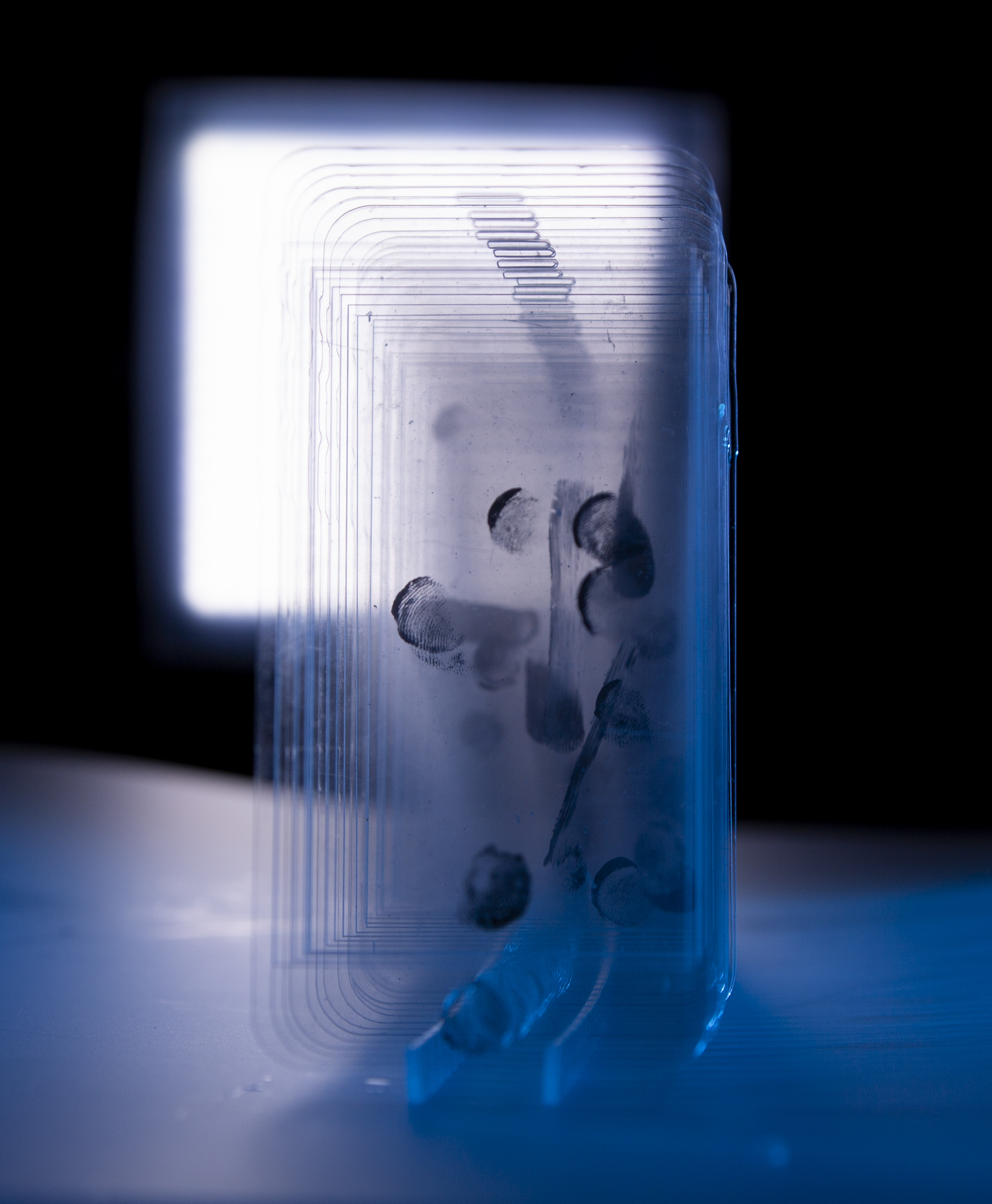
On Monday and Wednesday of last week, our group used the capture studio to take our final pictures for our zine. The light it the capture studio totally changed the way that all of the work I had made looked. Not only was it amazing to see the work I had made change character in different colors of light, but also it was incredible to see the work of all of my group come together in dialogue.
I loved seeing the way that light worked through the phone screens rather than being reflected back towards the viewer. The subversion of visibility was really beautiful, and the shadows that these moments of gesture created were so soft, but also so uniform.
Image of 40 gesture slides in circular configuration
In addition to playing with the spacing and configuration of the 40 cross sections of a conversation, I decided to re-photograph the pieces of plastic that I had cut with the laser cutter to make my embossing. They had become the ‘active’ component in the embossing-the things that you can touch for the sake of touching, but here I wanted to make them untouchable and inert, as well as holy. I thought to do this by putting the apps, in their clean, white perfection, in water.
Two Friday’s ago, our group went out and did some additional research by immersing ourselves in White City. Throughout the project, our group had informally been observing people on the tube, but the explicit intention of going out to observe and talk to people for an hour about their phone usage did change our outlook. We asked people who were walking around White City how they felt about their phone usage, and we got a variety of responses from a variety of age groups.
We asked a group of three boys in White City how they felt about their phone use, and specifically I asked one boy, “Do you think you use your phone too much?” He said, “Definitely.” We asked his friend though, and he responded initially that it wasn’t a problem, but then he thought, “Well, yeah, maybe.” We asked what they spent most of their time on, and the answer from all three boys was, in unison, “games”. They must have been somewhere between 10 and 12 years old.
We talked to some more people on the street, and we got answers varying from “It’s my best friend,” to “Eh, it’s normal to spend all day on my phone,” to “I definitely feel bad about it.” People were surprisingly open to talking about it though.
Research from immersion in White City
Additionally, we attempted to quantify phone engagement at particular spots by tallying at certain light posts and taking photos.
This communal perspective shifted my way of looking at the work that I was making. I had been focusing pretty heavily on the relationship that I had with my phone, but I was paying less attention to the communal rituals of touch.




 RCA Graduate Diploma